GetResponse email verification options
When mailfloss finds an invalid email in GetResponse, the Cleanup tab of your GetResponse integration decides what happens. You have five options. The setting applies to every list in the connection, and you can change it any time.
Before you choose an option, connect GetResponse to mailfloss. You only do this once. From then on, mailfloss verifies the emails in the connected GetResponse account automatically.
Here are the five options in the Cleanup tab:
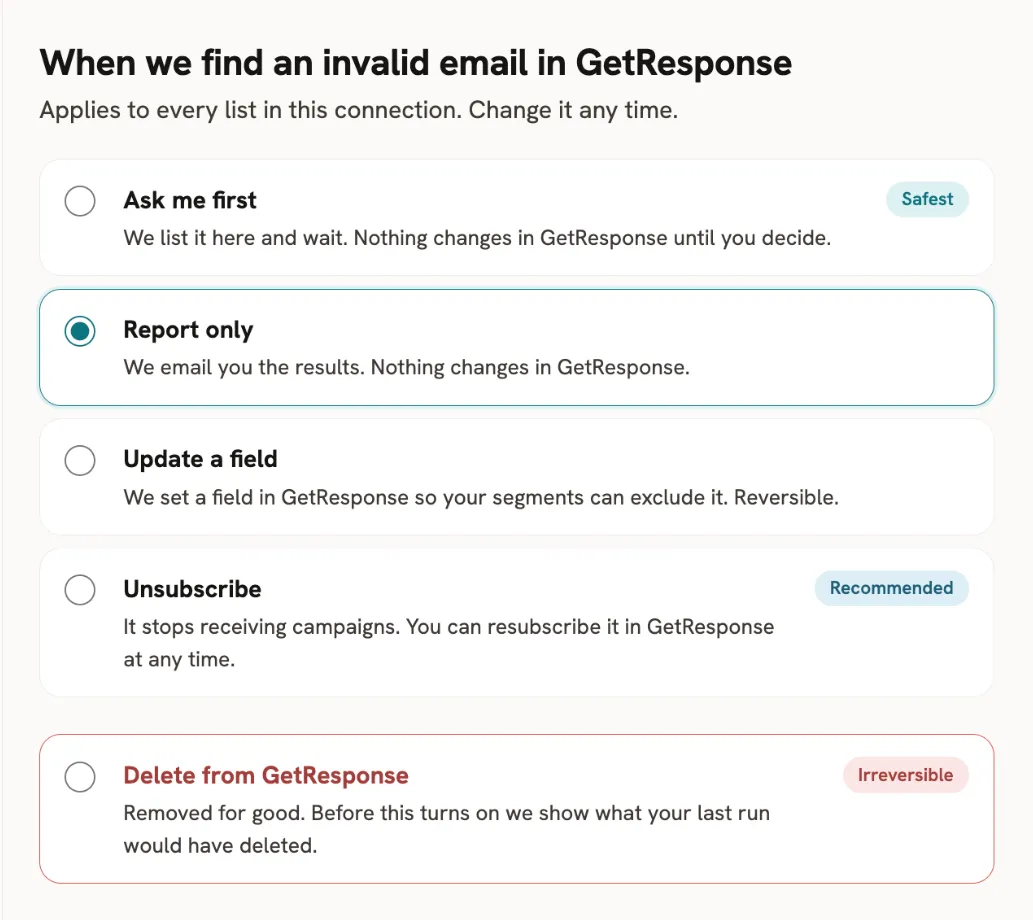
Ask me first. The safest option. mailfloss lists invalid emails in the Waiting for you tab, and nothing changes in GetResponse until you decide.
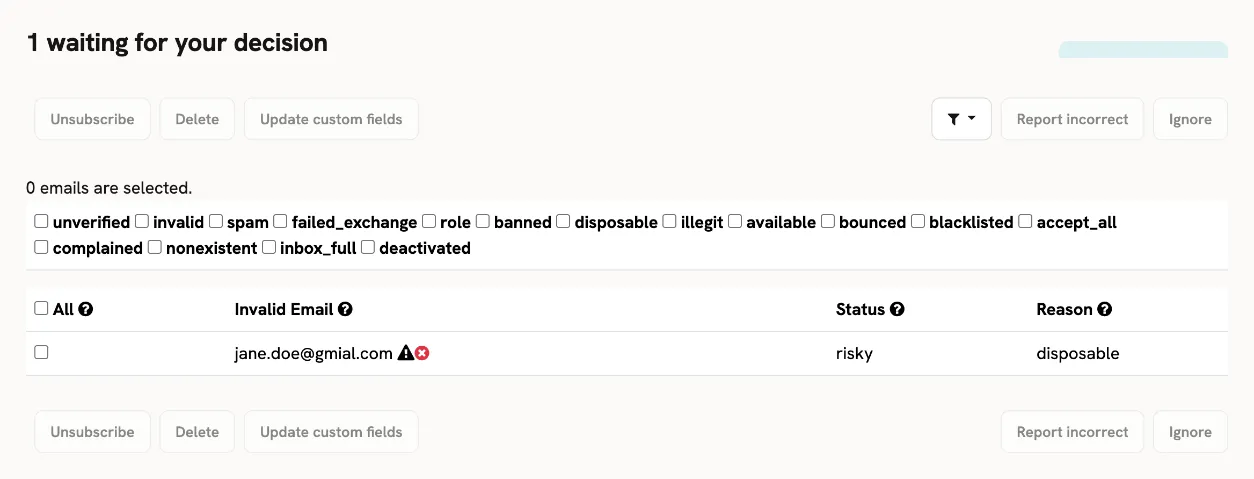
In Waiting for you, select emails and choose Unsubscribe, Delete, or Update custom fields. You can also mark them Report incorrect or Ignore, and filter the list by category.
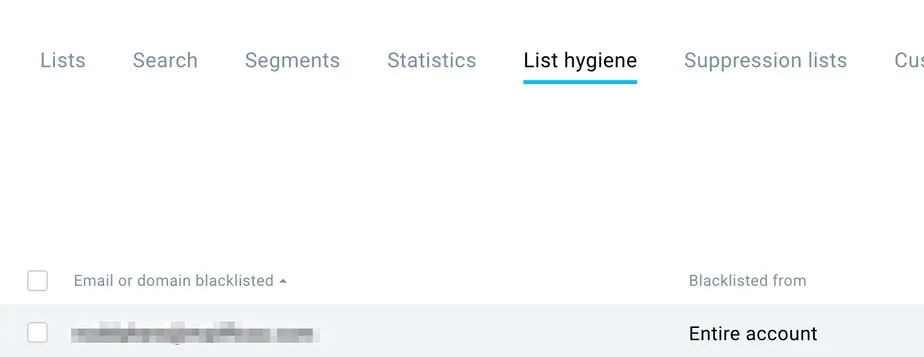
Unsubscribe. The recommended option. mailfloss unsubscribes the contact in GetResponse by adding a blacklist mask for it, so it stops receiving campaigns. You see the contact in GetResponse under List Hygiene. You can resubscribe it in GetResponse at any time. When you choose this option, mailfloss asks you to confirm. Turn on the switch under Unsubscribe to also update the fields.
Delete from GetResponse. Irreversible. mailfloss removes the contact for good, and you won’t find it in GetResponse anymore. Before this option turns on, mailfloss shows what your last run would have deleted and asks you to type the account name to confirm.
Update a field. mailfloss writes the verification result to custom fields in GetResponse, so your segments can exclude invalid emails. You can also use them to sync with your other databases and CRMs, and to run automations, segments, and reports. This is reversible.
For more information about our custom fields check this article.

Report only. mailfloss emails you a report of the latest floss session. Nothing changes in GetResponse. Choose this option if you only want the verification statuses for the connected GetResponse account, like a traditional email validation service.
For an overview of what mailfloss does for GetResponse, see the GetResponse integration page.